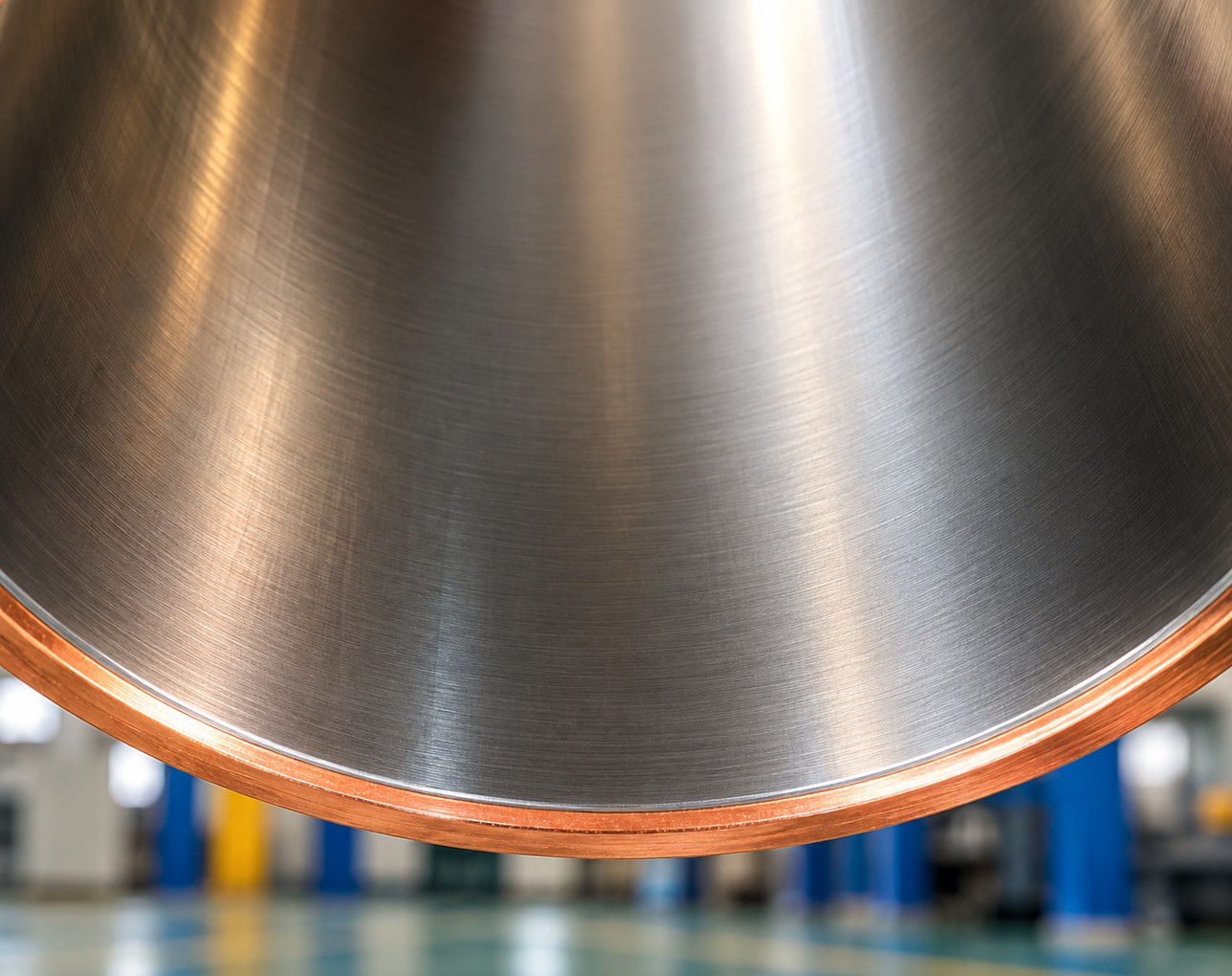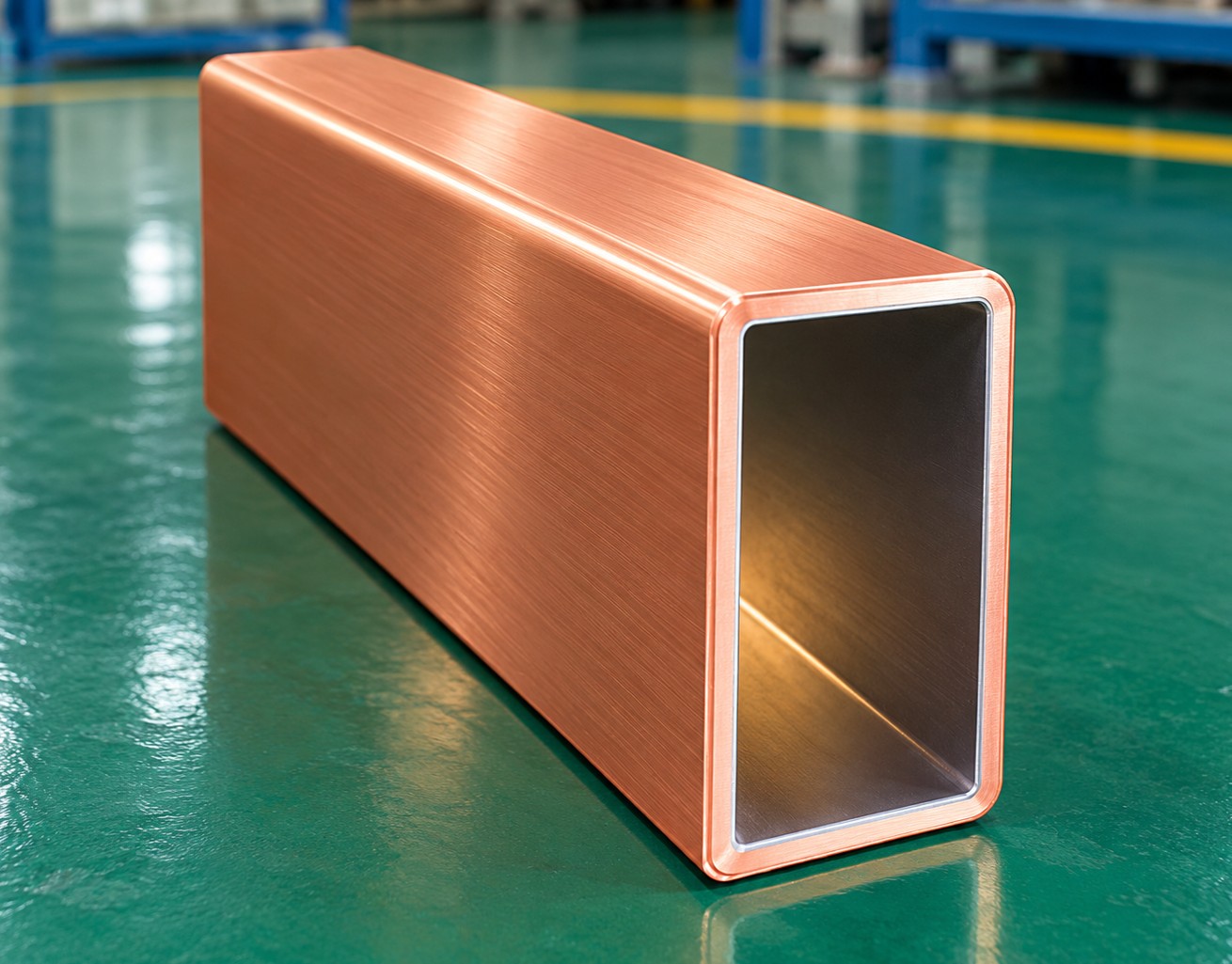

If you cut a mould tube lengthwise you would see that the bore is slightly larger at the top than at the bottom. That difference, the taper, is measured in fractions of a percent per metre and it decides more about casting quality than any other tube dimension.
Liquid steel meets the copper at the meniscus and freezes into a thin shell. As the shell moves down it cools and contracts. A parallel bore would leave an air gap between shell and copper within the first 100 mm; heat transfer through that gap collapses, the shell thins, and at the exit it may not be strong enough to hold the liquid core. The bore therefore narrows to keep the copper in contact with the shrinking shell. Too much taper and the shell is squeezed: friction rises, the oscillation marks deepen and the tube wears in the corners.
One straight line from top to exit, typically 0.6–1.0 %/m. Cheap to machine and to measure. Adequate for low casting speeds where shrinkage is roughly linear over the mould length. Over-tapered near the exit and under-tapered near the meniscus, so it cannot be used at high speed.
A steep taper in the upper third, where shrinkage is fastest, then a flatter taper to the exit. The most common design on billet casters built in the last thirty years; it captures most of the benefit of a curved profile with straight-line machining.
Three, four or more straight segments approximating the shrinkage curve. Each segment is specified on the drawing with its length and taper. Used on faster casters and for peritectic grades whose shrinkage curve has a knee.
A smooth curve calculated from the shell shrinkage model for a given speed and steel grade. The gap is minimal along the whole length, giving the highest heat flux and the most uniform shell. It is the standard for high-speed billet casting (above 3.5 m/min) and needs CNC contouring to machine and a CMM to verify. Convex-wall variants also exist.
| Parameter | Typical |
|---|---|
| Total taper, billet | 0.6–1.2 %/m |
| Upper segment (double taper) | 1.2–2.0 %/m over the first 250–300 mm |
| Lower segment | 0.4–0.7 %/m |
| Corner radius | R3–R12 mm; the corner taper is often slightly larger |
These are orientation values. The correct taper comes from the caster OEM's design or from a shrinkage calculation for your speed and grades; we do not apply one fixed taper to every order.
On a CMM, the bore is probed at five or more levels along the arc of the casting radius; the report lists the section at each level and the resulting taper per segment. On the shop floor a plug gauge set or a bore gauge on a curved track is used. A worn tube is measured the same way: if the exit section has grown by more than about 0.3 mm, the taper is gone and the tube should be re-machined or replaced, whatever the chrome looks like.
Either send the OEM drawing, or state the type and values ("double taper, 1.6 %/m over 280 mm then 0.55 %/m"), or give us speed, section and grades and let us propose. What we cannot work with is "standard taper".
Up to a point: faster casting means less time to shrink inside the mould, so the taper near the meniscus is steeper, but the total is similar.
Yes, by re-machining the bore, if the wall has enough allowance. See our repair article.
For the machines we supply regularly, yes; tell us the OEM and model.
Related pages: Copper Mould Tubes · Technical data: taper · Wall thickness · Repair and re-plating · Request a quote